


Being Dyslexic: The Barriers, the Belief and the Opportunities
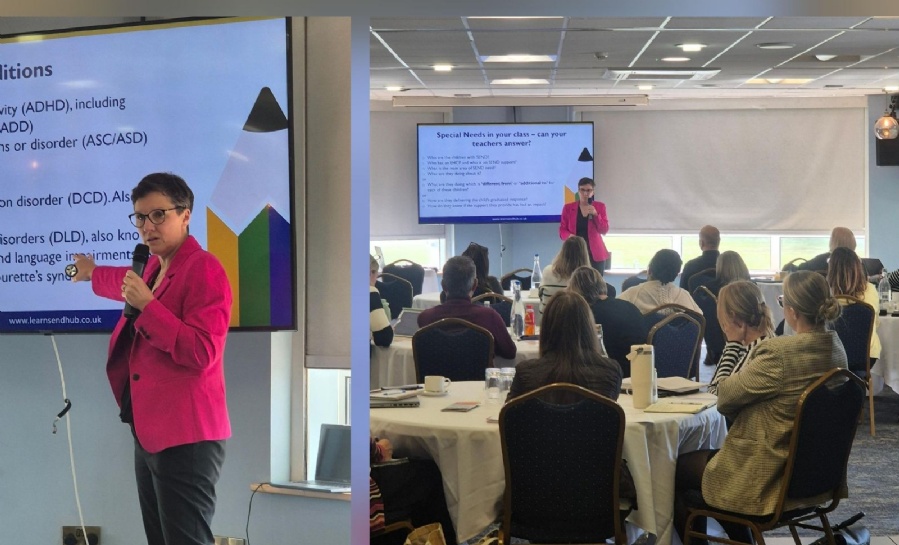
Our Director, Emily Walker has written about her personal experience about being dyslexic.
I have been thinking for some time about whether I should write about being dyslexic.
Not because it is something I am ashamed of. Quite the opposite.
But because my experience of dyslexia has been complicated. There have been times when it has felt like a barrier, times when I have wished my brain would just work in the way that the education system seemed to expect it to, and times when I have come to recognise that the way I think is also one of the things that has made me who I am.
Today, I work in education supporting schools, teachers and leaders to understand inclusion, SEND and the barriers that children and young people can experience. I talk about dyslexia. I talk about my own experiences. I sometimes talk about my children's experiences too.
And I often find myself thinking about the child I was.
What made the difference for me wasn't that dyslexia disappeared.
It was the people who believed I could succeed.
A wonderful start
I had a wonderful start in life.
My primary school was a lovely, supportive place. I had opportunities to take part in sport, creative activities and all sorts of things that allowed me to discover what I was good at.
And I was good at lots of things.
I remember the pride I felt when I achieved something in sport or through a creative activity. Those experiences gave me something really important: a sense of “I can.”
Some of the more academic learning was harder… But that didn't mean I couldn't do it.
The difficulty was often in the processing and, particularly, getting what I knew onto paper. My spelling was a significant barrier. I could have the words in my head, know exactly what I wanted to say, and yet not know how to write them down.
That can be a very frustrating experience for a child.
You know you know something, but the evidence on the page doesn't show it.
Fortunately, the educators around me understood that.
They empowered me. They enabled me. They found ways for me to demonstrate what I could do rather than allowing the things I found difficult to define me.
Even now, I look back on my primary years with enormous gratitude and very happy memories.
I felt successful.
Looking back, I think that made a huge difference.
Things changed a little when I went to secondary school.
It was still a positive experience in many ways, and I still had opportunities to flourish. But I became much more conscious of the things I found difficult.
The red pen is something I remember particularly well.
Every spelling mistake corrected.
Every word that wasn't quite right.
And when you already feel uncertain about your academic abilities, seeing those mistakes marked out in red can start to feel like a judgement on you, rather than simply feedback on your spelling.
The important thing is that I could do it.
I didn't need someone to tell me that I wasn't capable.
I needed someone to help me find the way to do it.
Then came Year 9.
We all sat the examination for entry into the selective schools in the area. One of my friends passed.
I didn't.
I remember thinking:
Why?
I couldn't understand it.
I went home and talked to my mum and dad.
I remember saying, “I don't get it. Why am I not able to do this? I'm equally as able.”
And my parents listened.
They didn't simply accept the outcome.
My mum was a special needs coordinator at the time and was also working towards her British Dyslexia Association qualification. She had relationships with people who could help us understand what might be happening.
At this point, I had already been having additional tuition around spelling, spelling practice and ways of storing and retrieving information. My mum was learning more about dyslexia at the same time.
It was a slightly complicated arrangement!
My mum and I were very alike, which meant that sometimes we clashed. The support she wanted to give me wasn't always the support I was ready to accept.
Looking back, though, I am incredibly grateful that she didn't just accept the label of “not passing.”
She asked why… And that question changed things.
Finding out I was dyslexic
I was assessed by an educational psychologist.
There were lots of assessments and lots of conversations.
And eventually it became clear.
I was dyslexic.
Quite significantly dyslexic… And I also had a high IQ.
Suddenly, there was an explanation for something I had been experiencing for years.
The assessment didn't make me more capable.
I was already capable.
What it did was help explain the mismatch between what I could think and what I could sometimes get onto paper.
That distinction has stayed with me throughout my career.
A difficulty with demonstrating something is not the same as a lack of ability.
The evidence from the assessment enabled me to move into the selective school.
And that came with its own interesting experience.
I remember being told by people from my previous school:
“You only got in because of your mum.”
“You're never going to be successful.”
“You won't get any GCSEs above a C, apart from one.”
That was incredibly dismissive.
And, if I'm honest, it was offensive.
But it also gave me something to prove.
I went on to achieve 11 GCSEs at grade C and above.
For me, that was a huge achievement.
Not because of the grades themselves, but because I had been told what I wouldn't achieve, and I discovered for myself what I could.
At that point, I didn't want extra time or additional support.
I wanted to prove to myself that I could do it.
Perhaps I was making things harder for myself than they needed to be.
But at that stage of my life, I needed to find my own confidence.
And once again, it wasn't just academic achievement that kept me going.
Sport and creative opportunities gave me somewhere else to succeed.
They gave me space to flourish in different ways.
They reminded me that success doesn't come in one shape.
University: discovering the teacher I wanted to be
University was a really great time in my life.
I had the opportunity to do lots of the things I loved and, as part of my course, I worked in four different schools.
Every one of those schools inspired me in a different way.
Each one made me think about what a privilege it is to be a teacher and to work with young people.
But they also made me think about something else:
How do we understand the challenges young people face, and how can we do things differently?
I was fortunate to train at a time when there was considerable flexibility within the curriculum.
We could find a theme, pull different threads together and follow the children's curiosity.
We could explore their questions.
We could make learning exciting.
Looking back, those opportunities were phenomenal.
They shaped my understanding of teaching.
They also shaped my understanding of inclusion.
Because inclusion isn't simply about making sure someone is in the room.
It is about whether they can participate.
Whether they can contribute.
Whether they can demonstrate what they know.
Whether they feel that they belong.
And whether we are prepared to change something about the way we do things so that they can succeed.
Becoming a teacher
I qualified as a primary teacher, specialising in the junior years.
And, perhaps inevitably, my dissertation was:
“It's not my fault I'm dyslexic?”
It was quite a lot of writing for someone whose dyslexia made getting thoughts onto paper challenging!
But I loved doing it.
I was fortunate to have people around me who supported me through the process and helped me find ways to structure my thinking.
Because that is one of the things I have learnt about dyslexia.
Sometimes the thinking is not the problem.
In fact, sometimes the thinking is the strength.
The challenge can be organising all those thoughts, selecting the right ones, sequencing them and translating them into the format that somebody else expects.
My team now laugh because they call me a squirrel.
I jump from one thought to another.
“Oh, we could do this.”
“And what about that?”
“That reminds me…”
“Actually, if we linked that to this…”
There is usually a lot happening!
But perhaps that is part of the way my brain works… And over the years I have learnt to value that rather than simply trying to suppress it.
My first teaching job: London
My first teaching job was in inner-city London.
It was an incredible experience.
I came from a rural county, and suddenly I was working with young people whose experiences of life were very different from mine.
They taught me so much.
About community.
About resilience.
About supporting one another.
About finding joy.
About the importance of belonging.
We developed our own little context as a class. We cared about one another and understood one another.
And, importantly, it didn't matter what someone's need was or what label they had.
We helped each other.
I was also incredibly lucky with my first headteacher.
She was supportive, empowering and enabling, but also deeply caring.
She showed me what leadership could look like.
I remember thinking that if I ever became a leader, I wanted to be the kind of leader she was.
That experience has stayed with me.
From the first computer to a changing education system
I became an IT coordinator almost by accident.
I was one of the few people in school who felt confident using computers, and perhaps one of the few who had enough capacity to take it on!
This was at the very beginning of the development of the computing curriculum and widespread use of the internet in schools.
I remember having one computer with internet connectivity.
We all sat around it in the library, looking at the tiny screen.
It sounds extraordinary now.
But at the time, we were simply using what we had and trying to make the most of it.
That experience opened another door for me.
I became an IT trainer and worked with schools through the government's New Opportunity Fund.
Again, I was lucky.
I worked with brilliant people who brought different knowledge, skills and experiences.
We played to each other's strengths.
We worked hard.
We laughed a lot.
And we achieved an enormous amount together.
That experience reinforced something I had already begun to understand:
We don't all need to be good at the same things.
A strong team isn't one where everybody has the same strengths.
It is one where people recognise what they each bring and find ways to work together.
Seeing education through different lenses
I later travelled and spent time in Australia, where I also did some tutoring.
Again, I found myself looking at education differently.
I saw different approaches to learning and different expectations from families.
There was a strong desire to give children the best possible chance of success, alongside an expectation that standards should improve.
But there was also something that really stayed with me:
We had to make learning fun.
There were things we had to deliver.
There were standards to meet.
But the learning needed to come alive.
It strengthened something I already believed about learning: if we make it exciting and engaging and something that young people want to be part of, we have a much better chance of helping them succeed.
Where learning becomes rigid and something that is simply done to children, engagement can look very different.
That is why I remain such a strong believer in a strengths-based approach.
Start with what children can do.
Build from there.
Dyslexia didn't hold me back
As my career developed, I moved between mainstream primary and specialist provision.
I worked with an extraordinary range of colleagues and young people.
And I learnt from all of them.
In specialist settings particularly, I saw the power of those moments when something that had seemed incredibly difficult suddenly clicked.
That light-bulb moment.
The smile.
The pride.
The “I did it!”
As a practitioner, those moments are a privilege.
And throughout all of my teaching, one thing became increasingly clear to me:
If we don't have a relationship with a child or young person, learning becomes much harder.
We need to understand them.
We need to understand how they communicate.
What motivates them.
What makes them feel safe.
What they are good at.
What they find difficult.
And what we might need to do differently.
I didn't get this right every time.
Of course I didn't.
I still don't.
But every role taught me something new.
Perhaps dyslexia was also shaping the educator I became
I later became involved in curriculum development and the early literacy strategy work.
Interestingly, although dyslexia is often associated with difficulties in reading, some of the structured approaches used within the literacy strategy actually worked really well for me.
The explicit vocabulary.
The preparation before reading.
The structure.
The way language was introduced.
It gave me another perspective on how we can remove barriers to learning.
I also worked alongside colleagues supporting children with English as an additional language.
I remember particularly the creativity they brought to language acquisition, the props, resources and approaches they developed to help children understand and engage with language.
It made me think about my own experiences.
I wondered what might have been different if I had understood some of these approaches earlier.
Perhaps some of my journey would have been easier.
Where I am now
Today, I work in education supporting schools to think about SEND, inclusion and the barriers that children and young people face.
And I do talk about being dyslexic.
Sometimes I talk about my own experiences.
Sometimes, embarrassingly for my children, I talk about theirs too!
They often tell me that I have given them my best bits and my worst bits.
And they are probably right… Because dyslexia can be a real challenge.
Sometimes it is difficult to explain what you need in order to learn.
Sometimes it is difficult to get other people to believe that something genuinely is a barrier.
And sometimes the very things that can be strengths, creativity, making connections, thinking differently, seeing possibilities and thinking outside the box, can become challenges when the system expects everyone to work in exactly the same way.
A standardised approach to writing an essay doesn't necessarily work for every brain.
A prescriptive structure doesn't necessarily make thinking easier for everyone.
Sometimes we need flexibility.
Sometimes we need different ways of demonstrating understanding.
Sometimes we need someone to recognise that the barrier isn't a lack of ability.
The barrier is the way we are asking someone to demonstrate it.
The child I was and the educator I became
I sometimes wonder what the younger me would think if she could see me now.
The girl who couldn't always get the words onto paper.
The girl who saw red pen all over her spelling.
The girl who didn't get into the selective school first time.
The girl who was told she wouldn't achieve much.
The girl who didn't want additional support because she wanted to prove she could do it herself.
I think she'd be surprised… But I also think she'd recognise something.
The people who believed in me made a difference.
The teachers who saw beyond the spelling mistakes.
My parents, who asked why?
The leaders who empowered me.
The colleagues who valued what I brought.
The young people who taught me so much.
And the opportunities to succeed in different ways.
None of these things took my dyslexia away.
They didn't need to.
They helped me understand that dyslexia was one part of me, not the definition of me.
And perhaps that is the message I want to leave with educators.
Don't underestimate the child because of the thing they find difficult.
Don't mistake the barrier for the ability.
Don't let the way somebody currently demonstrates their learning become a prediction of what they might achieve.
Ask:
What can they do?
What are they good at?
What interests them?
What helps them learn?
What is getting in the way?
And then ask the most important question:
What can we change? Because sometimes it isn't the child who needs to change.
Sometimes we need to change the conditions around them.
And sometimes, when we do that, we discover a whole lot more ability than we ever expected.
I don't know whether dyslexia is a superpower.
My children certainly don't like me calling it that!
But I do know this:
It has shaped how I think.
It has shaped how I teach.
It has shaped how I lead.
And it has shaped how passionately I believe in creating opportunities for children and young people to flourish.
Not by chance… But by design.